The Inner Études
牆邊練習曲

Monzogranite (Ma On Shan Country Park)
The first official recorded and collected granite by Hong Kong Geological Survey in 1983
Hong Kong's bedrock tells a story spanning 140 million years. This hilly terrain, formed by a supervolcano and shaped by millennia of weathering and erosion, holds geological secrets beneath its urban surface.
Excavating through layers of granite reveals Hong Kong's history in reverse chronology: from contemporary urbanisation and industrial mining to geological formation. By tracing these strata backwards, we reach the pre-human era and unlock a perspective on Hong Kong's narrative that centres on geology rather than human development—a timeline that transcends conventional historical frameworks.
The Inner Études, commissioned by Tai Kwun Performing Arts in partnership with Vividly (a director-playwright duo from Macau), marks my first venture into site-specific immersive theatre and curatorial practice. Tai Kwun itself—a revitalised heritage compound encompassing the Central Police Station, Central Magistracy, and Victoria Prison—carries significance dating to Hong Kong's earliest colonial period.
Collaborating with director-playwrights Jay Lei and Jay Lee Shuk Man from conception through delivery, I served as associate director and researcher. My work involved surveying the compound's construction materials and establishing connections between granite geology, Hong Kong's mining and quarrying heritage, and urban development. The expanded creative team ultimately comprised 29+ members, spanning advisory, performance, lighting, sound design, scenography, costume design, and stage management roles.
House Programme PDF (with Biography and Credits)
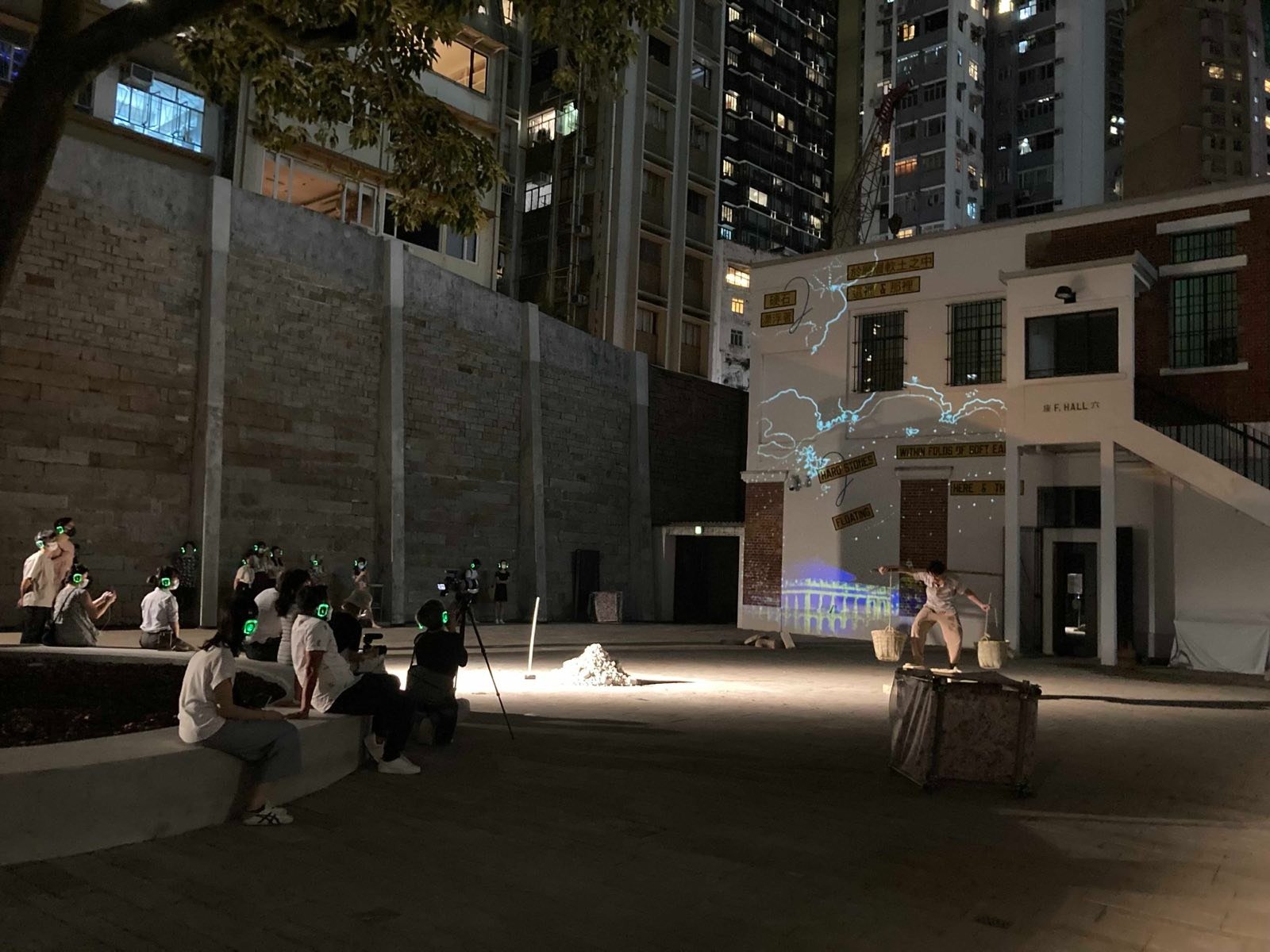
Image Description from left to right: The site-specific performance experience unfolds through moments within the revitalised heritage compound, where audiences wear headsets to immerse themselves in the outdoor night environment. The second images capture the illuminated prison building facade and granite wall, where light projections reveal Hong Kong’s stone quarrying production history. The final image documents a performer embodying a quarry worker, positioned against the projection.


Image Description from left to right: The first image depicts a stilt-walking performer inviting an audience member to touch the granite wall. The following images present gathered audiences before the granite wall as the elevated performer raises her arms.


Image Description from left to right: The first image captures a solitary performer, his silhouette framed against the colonial prison architecture’s shadow patterns. The second image reveals an immersive installation within the prisoner’s yard, where rectangular box structures and video projections of architectural fragments and maps layer the floor. The final image documents the performer descending the staircase among seated audiences.


Image Description from left to right: The first image captures a young geologist leaning over an illuminated map of Hong Kong. The second image presents audiences gathered around a performer examining archival materials and specimens in an interior study room. The final image shows a performer elevating a heavy stone suspended in the air before a large granite specimen on a wheeled platform.


Theatrical scenery of a
young geologist’s study room
戲劇場景: 年青地質愛好者的研究室
To extend public engagement beyond performance hours, we transformed the theatrical scenery into an accessible exhibition space. In collaboration with the scenography designer and playwright, I curated Theatrical Scenery of a Young Geologist’s Study Room—an immersive exhibition that invites audiences to explore the protagonist’s workspace and discover Hong Kong’s geological narrative through personal archives. The exhibition encourages multisensory engagement, inviting visitors to touch and examine archives, documents, maps, photographs, books, and granite specimens. This tactile experience deepens individual inquiry into Hong Kong’s geological history.
The Inner Études Exhibition

Image Description from left to right: The first image displays the exhibition text panel introducing Theatrical Scenery of a Young Geologist’s Study Room. The second image reveals the geologist’s study room installation in dim and ambient light. It features a large study desk, open shelves lined with archival boxes, oversized maps, photographs, books, and granite specimens—a spatial reconstruction that evokes lived research and geological inquiry. The final image captures visitors engaging directly with geological specimens and archival materials, their hands and bodies in tactile contact with the stone.


Image Description from left to right: The three images capture the exhibition space: a young visitor examining a granite stone specimen housed in an open display box with handwritten annotations, accompanied by adults; visitors gathered at a study table engaged in collective examination of old photographs.
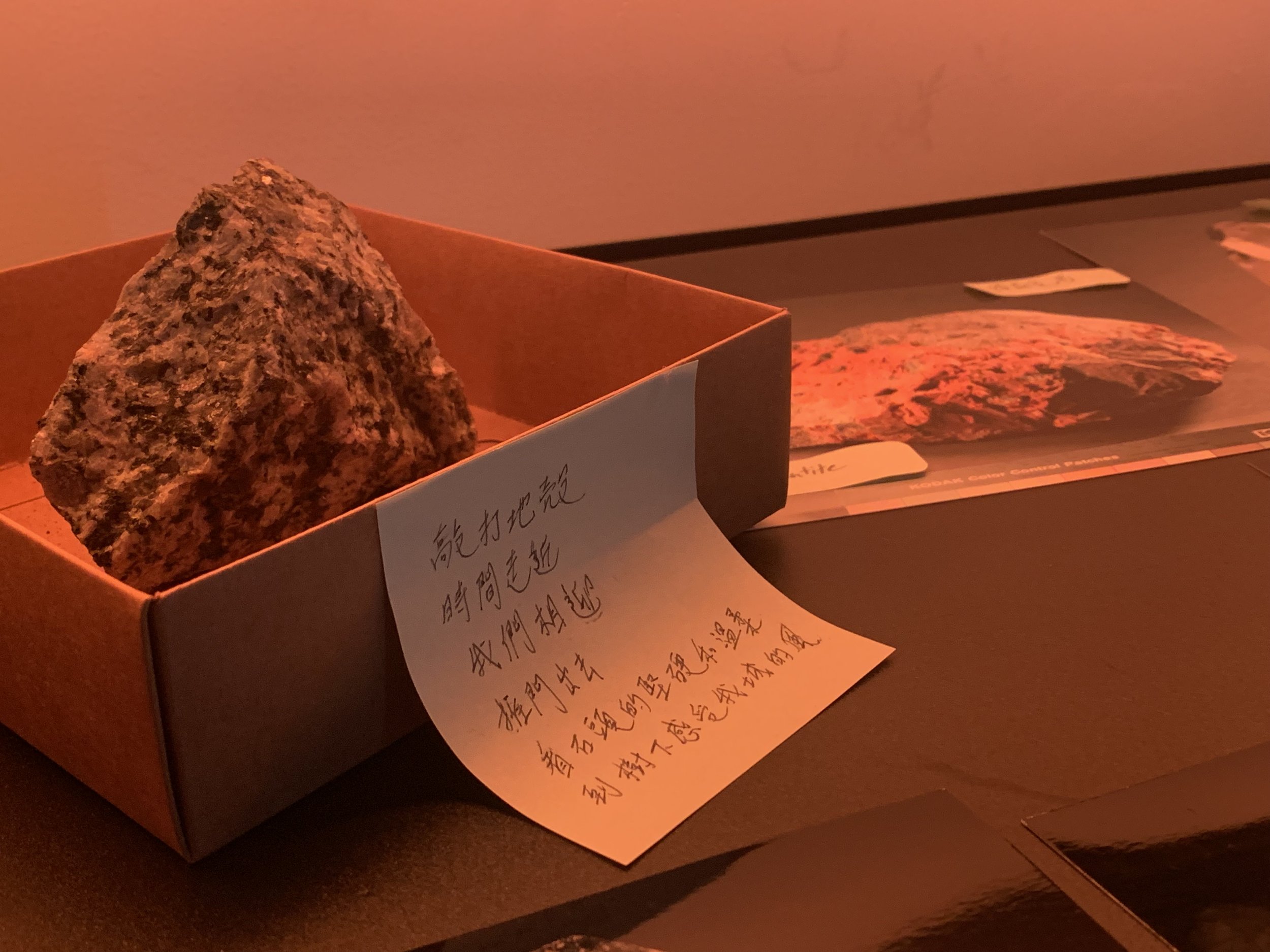


Image Description from left to right: The three images document the exhibition’s archival holdings: vintage maps annotated with handwritten notes, bound journals bearing geological observations and multilingual inscriptions, and historical geological records—materials that construct a genealogy of Hong Kong’s geological study and mining heritage.


Photo credit: Akimoto Chan, Chan So Yi and Mak Chi Hin